“Going upon the account” is what it was called when people people decided to embark on the dangerous journey of joining up with a pirate crew during the Golden Age of Piracy. Most of those who did it had been experienced sailors who had been successful privateers or soldiers during the wars that preceded the era, but found themselves unemployed and cast off without much in the way of a soft landing. Merchant captains were notoriously brutal and paid very poorly, and some decided they’d rather live a short life, and a merry one.
Well we’re in a rough economy again, worse than at any point in my employed life, and unfortunately me and a good number of my coworkers didn’t make it through this round of layoffs. I made it through many rounds before, I had figured one of these times would be my turn.
I feel fortunate to be sitting here with a dozen years of experience, rather than just starting out, as there are at least job listings I’m qualified for. Right now the reality looks pretty bleak for a new engineer on the job market. So far I’ve been getting an awful lot of silence for my efforts.
Given that I’ve suddenly found myself with a lot of free time, and am realizing the mental health toll that using that time to sit and worry is taking, I’ve decided to start building my first real game, outside the context of a game jam. It’s as of yet unnamed, but it’s going to be a multiplayer, procedurally-generated sandbox game with a mixture of city-building and pirate-adventuring in it. More specifics are to be worked out, but it’s the sort of game I’ve always wanted. The style will be cute and upbeat, and the gameplay will be a mostly laid-back social pirate game to play with my friends.
This is the sort of thing I’d wanted to make when I originally started my own business back in 2018: Danger Interactive / Danger Zone Games. Back then I didn’t actually have the technical skills to realize it, but now I do. Someday, if I’m lucky maybe this sort of thing can be my full-time job. If this job market continues to disappoint, maybe of necessity that time is now. So I guess you can consider this my “going upon the account” in a way.
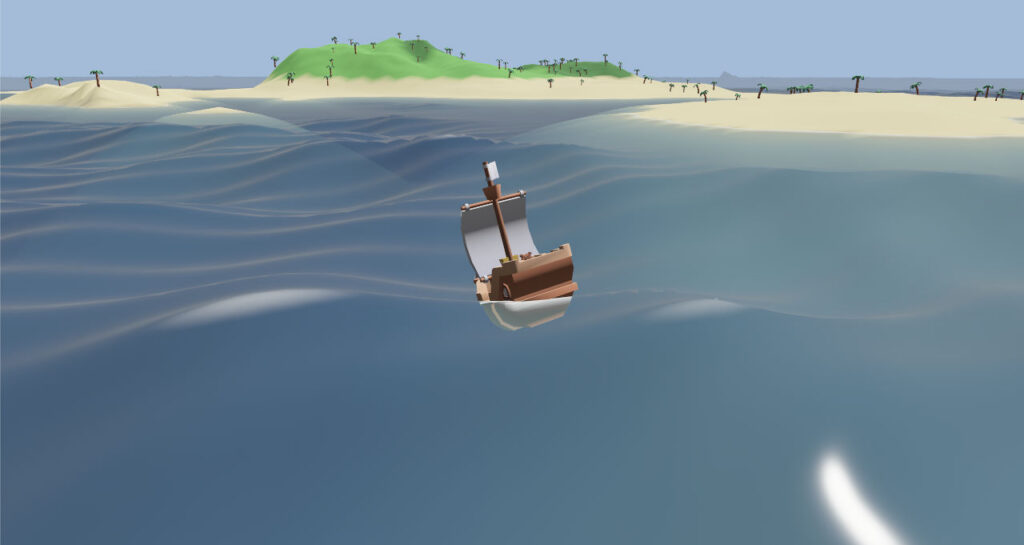
Here’s a screenshot of the progress so far:
I intend to write more about it as I continue working on it. Hopefully I’ll even make some fun little videos talking about the mechanics that excite me, or some interesting aspects of the development.
The game is being written in Rust using the Bevy game engine. It’ll be compiled natively for Linux, Windows, and MacOS, and I plan to release it on both Steam and Itch.io, and plan to test on the Steam Deck specifically throughout development to ensure it runs flawlessly there and on devices with similar capabilities and controller layouts. I also plan to release playable demos before release.
So far there’s not a ton to do, but the technical foundation is being laid.
It’s being built with multiplayer networking as a first-class feature from the start, which should avoid lots of refactoring later. Rather than trying for the ambitious goal of a hosted MMO and all of the impossible overhead that would entail for a team of one with $0 of starting cash flow, I’m leaning into more of the community-driven model of Minecraft. Players will be able to host their own private or public servers, and when played in single player it’s technically spinning up a server in the background that can be switched into multiplayer mode so you can invite your Steam friends or play with others on LAN for those who still hang out with their friends IRL.
The terrain is infinite (or, infinite in the same way Minecraft is, eventually you’ll get far enough away that floating point precision causes weirdness, but it’d take literal months or years to sail that far). It’s generated using multiple layers of Simplex noise fields with multiple passes of post-processing to shape the terrain into a consistently interesting infinite archipelago. Though that part is sorely in need of a more maintainable architecture to support the massive amount of features I plan to add to terrain generation. Right now it’s probably the messiest part of the codebase.
The ocean is also really cool. It’s technically just a big flat plane on the CPU-side. On the GPU, it’s using a vertex shader that takes a bunch of Gerstner wave parameters via uniforms, and it simulates the waves entirely on the GPU. I still need to add functionality to the multiplayer server to ensure all players are on synchronized clocks so they see identical waves, but that’ll be worked out soon. Unlike something like Sea of Thieves, this game won’t be as realistic a simulation, so at least tentatively it seems okay for minor desync there, which allows saving a lot of CPU resources.
The physics of the ship riding across the waves is implemented by probing a few samples on the same Gerstner wave function, this time on the CPU-side, but since it only needs to sample a limited set of vertices, it requires much fewer resources than simulating the entire ocean on the CPU-side.
(Also, in case you noticed the cool background on the homepage of this blog: that’s not a video, it’s actually a real-time simulation of Gerstner waves happening in your GPU via WebGL2 and rendered like a topo map, it was my way of playing around with Gerstner waves before starting this game project)
Similar to Sea of Thieves, the waves become less pronounced as you get close to islands. That way harbors and along the shore are nice and steady and perfect for docking or anchoring.
And the water’s fragment shader is pretty neat as well. It uses multi-pass rendering. So in the first pass, it renders the whole scene without the water, including a depth buffer. Then, it renders the water in a second pass and gives it access to the frame buffer and depth buffer from the previous pass. The opacity of the water is calculated by the distance between the depth of the fragment being rendered on the water’s surface, and the depth of the pixel at the previous pass. If the previous pass depth is closer, the vertex is dropped (because the water is occluded), and if the previous pass depth is further away, then we know exactly how much water that ray of light is passing through, and can tint it according to that thickness of water. This allows fairly realistic-looking water. Obviously it’s not refracting accurately, but for the style of this game, I think that’s certainly okay, and the added complexity and performance impact of truly realistic refraction doesn’t seem justified. I am getting some odd artifacts where a fragment represents a ray passing through both a front and back face of a wave, and I’m still trying to figure out what causes that, but I suspect it’ll be a very small adjustment to an otherwise fairly complex shader that works far better than I thought I’d be able to do on a first try.
And regarding the performance goals, for the time being basically nobody can buy computer parts anymore thanks to AI datacenters, so it’s an explicit goal of my game to be low-end-hardware-friendly. I want my game to run flawlessly on a steam deck, or a crappy old laptop. I think the lower the friction necessary to play, the more likely it is for people to be able to bring their friends together to play, and that’s the whole point.
Anyway, hopefully I’ll have more to share soon, so keep an eye out if you’re interested in the game. And if you happen to know of any good job opportunities, I’m on the job market. Here’s my resume.